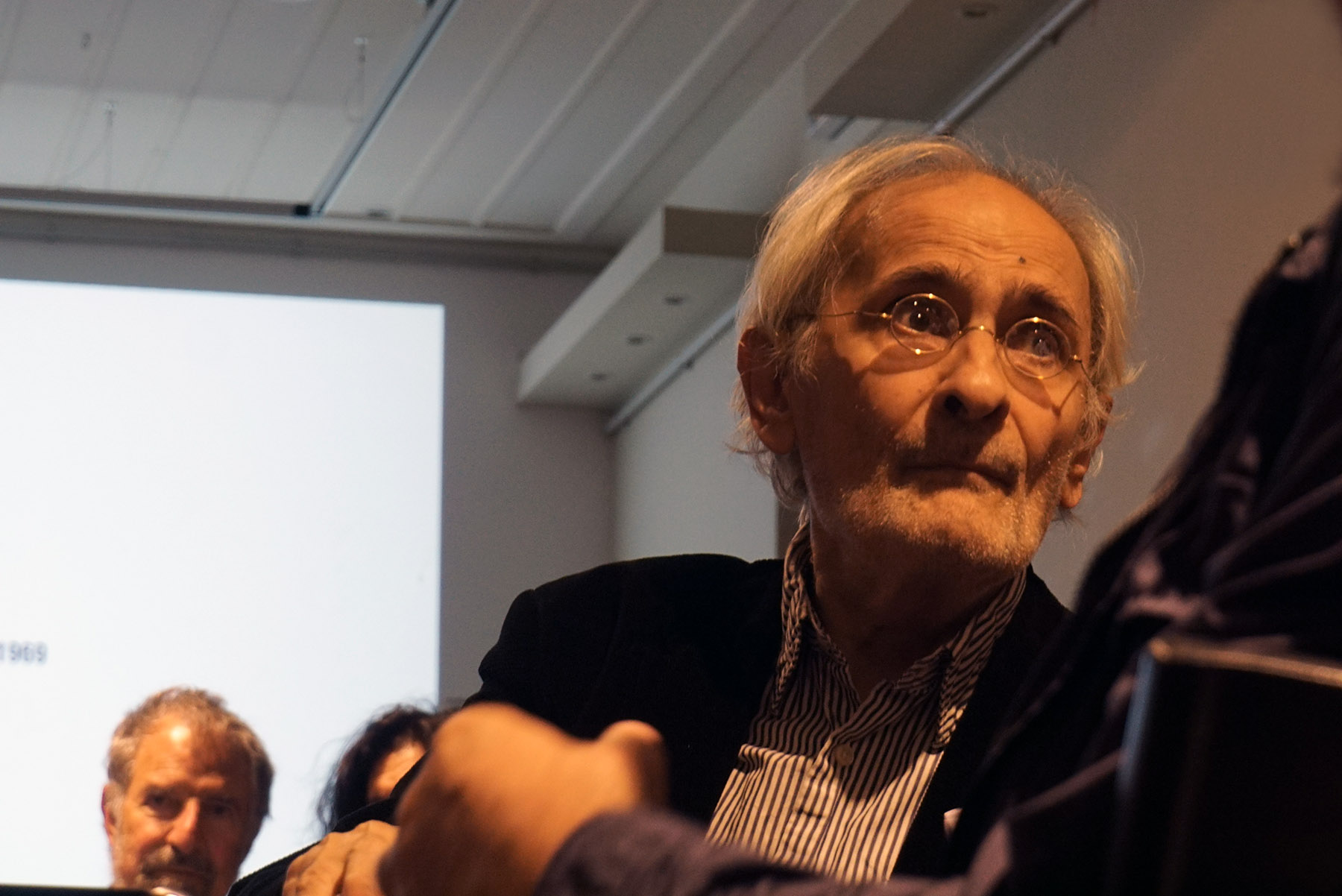
With great sorrow, MOMUS announces the death of Alexander Tzonis.
Alexander Tzonis (Αλέξανδρος Τζώνης, 8 November 1937, Athens - 1 March 2026, Paris) was a distinguished and influential Greek-born architect, theorist, and educator known for integrating scientific and humanistic approaches in architectural theory, history, and design cognition. Educated at the National Technical University of Athens (1956–1961), he was influenced by Spyros Papaloukas and Dimitris Pikionis, and worked in stage design, contributing to Jules Dassin’s “Never on Sunday” (1960). In 1961 he moved to the United States studying at Yale under Paul Rudolph, Shadrach Woods, Robert Venturi, and Serge Chermayeff. He later taught at Yale and Harvard Graduate School of Design, where he introduced analytical design methods and co-developed applications of the ELECTRE evaluation system. His 1974 book “Towards a Non-oppressive Environment” critically examined the socio-environmental crisis of modern urbanism. In 1981 he became Crown Professor at Delft University of Technology, founding the Design Knowledge Systems (DKS) institute (1985–2005), focusing on architectural cognition and creative design by analogy. With Liane Lefaivre, his long-time partner and collaborator, he co-introduced the concept of Critical Regionalism and authored influential works on classical architecture and modern design thinking. Tzonis has held numerous international visiting professorships in Europe, America and Asia and received multiple honorary distinctions for his scholarly contributions.
Alexander Tzonis was a close friend and supporter of MOMUS-Museum of Modern Art. Through the “Tzonis - Lefaivre donations” the museum’s collections were enriched with an important corpus of early drawings by Chryssa (Vardea), with whom Alexander Tzonis shared a longstanding friendship. Among the donations is a significant body of photographs documenting everyday life in Greece during the 1960s. He also donated the architectural archive of his grandfather, Alexandros Tzonis (1877-1951), a renowned architect responsible for seminal buildings in Istanbul and Thessaloniki. MOMUS has organised two important exhibitions based on the Tzonis - Lefaivre collections: “Spring Torrents. Harvard Strike Posters. Spring 1969” (26.9.2018 – 7.4.2019) and “Light Negative Positive - The Greekness of Chryssa” (14.10.2022 – 9.1.2023).
MOMUS is also planning a publication dedicated to the life and architectural work of his grandfather, the distinguished architect Alexandros Tzonis, whose archive is preserved in the collections of MOMUS-Museum of Modern Art-Costakis Collection.
We extend our heartfelt condolences to his partner and collaborator, the architectural historian and theorist Liane Lefaivre.
Caption
From a talk event with Alexander Tzonis, Harvey Hacker and Liane Lefaivre, in the frame of the exhibition "Spring Torrents. Harvard Strike Posters. Spring 1969, Alexander Tzonis and Liane Lefaivre Collection", MOMUS-Museum of Modern Art, 24.10.2018.

From a talk event with Alexander Tzonis, Harvey Hacker and Liane Lefaivre, in the frame of the exhibition "Spring Torrents. Harvard Strike Posters. Spring 1969, Alexander Tzonis and Liane Lefaivre Collection", MOMUS-Museum of Modern Art, 24.10.2018.

Talk event with Alexander Tzonis in the frame of the exhibition “Light Negative Positive – The Greekness of Chryssa”, MOMUS-Museum Alex Mylona, 14.10.2022.

Talk event with Alexander Tzonis in the frame of the exhibition “Light Negative Positive – The Greekness of Chryssa”, MOMUS-Museum Alex Mylona, 14.10.2022.

Alexander Tzonis (on the right) with the designer of the emblematic poster "The Fist", Harvey Hacker (on the left), MOMUS-Museum of Modern Art, 24.10.2018.

Alexander Tzonis, as professor at Harvard University, 1969.